Posted on 13 March 2013 by Norm Rose

Today’s Travelport /American Airlines announcement marks a watershed moment in airline travel distribution. Over the last six months the two camps seemed to be solidifying their positions.
On the airline side the purchase of the Open Axis Group schema by ATPCO followed by the IATA’s announcement that their New Distribution Capability (NDC) would embrace the same Open Axis Group standard, aligned the airline distribution approach around a single methodology (created by Farelogix). The stated goal of the airlines is to gain more flexibility to offer customized products and services to individual travelers based on their preferences and value. Despite recent press to the contrary (NY Times, Fox News), I do not believe this is anti-consumer, but rather a valid attempt to get in line with the general e-commerce trend towards greater personalization.
The opposing forces representing corporate buyers (BTC), TMCs and the GDS seemed to continue to spend considerable marketing dollars to counter this Open Axis Group/NDC/Farelogix effort with the argument that more personalized offers would lead to a lack of transparency, higher airfares and hamper the consumers’ ability for competitive shopping. It is interesting to note that while the GDS where lobbying to derail NDC/Open Axis/Direct Connect, all have spent considerable money on implementing travel agent desktop point of sale platforms that are able to integrate airline ancillary products. Up until today those ancillary products still needed to be distributed through the traditional channel (ATPCO/EDIFACT).
As the first of the three GDS to embrace the Open Axis Group/NDC/Farelogix standard to allow full access of ancillary services and ultimately allow the airlines to offer unique bundles and pricing to customers, Travelport is using their Universal Desktop to truly be an aggregator of multiple sources of inventory. Considering that the roots of the Universal Desktop came from Travelport’s purchase of the assets of G2 Switchworks, an early proponent of alternative distribution is quite ironic. I am hopeful that this marks the beginning of the end of this airline/GDS battle allowing all channels access to full content and services while allowing the airlines to better market their products in an era of hyper personalization.
Posted on 19 February 2013 by Norm Rose

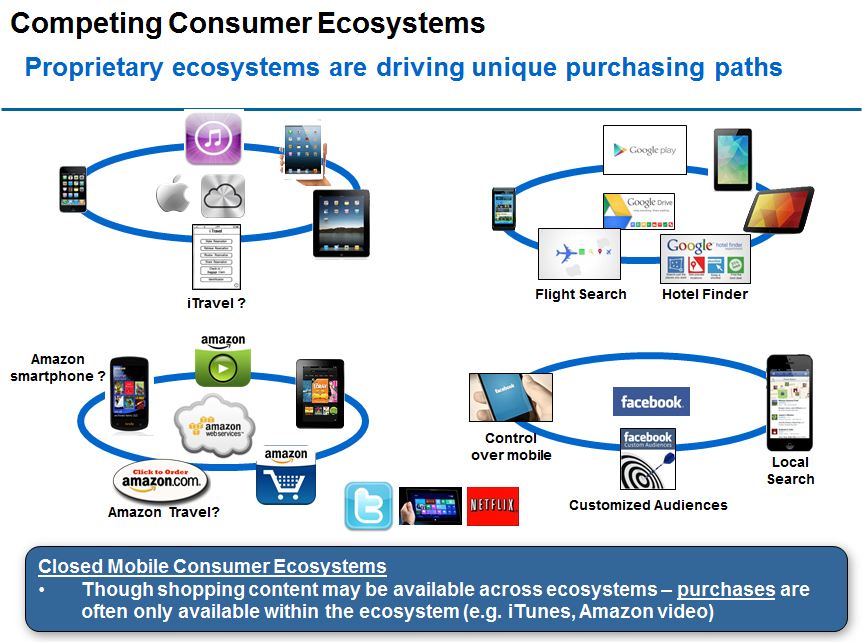
I was in Miami last week attending the Farelogix Media Day. My presentation entitled The Future of Travel Distribution can viewed via SlideShare. Part of my presentation discussed how competing consumer ecosystems (Apple, Google, Amazon, Facebook) provide unique content and purchasing paths via mobile devices.
Over the next five years mobile devices (including tablets) will become the foundation for most travel e-commerce. As a result airlines can create their own mobile ecosystems around their alliance/joint venture partners
;
Soon airlines will be able to offer specific targeted content to their best customers directly to their mobile device creating a true personalized direct distribution ecosystem.
Posted on 08 February 2011 by Norm Rose

Since my December post, a number of developments have occurred on the evolving travel distribution front:
- Sabre and AA have called a temporary truce and are in negotiations to resolve their conflict
- Priceline has embraced the AA direct connect strategy clearly following an independent path from Expedia and Orbitz
- USAir has signed a multi-year agreement with Expedia which includes the sale of Choice Seats
- Travelport has announced a new agreement with Air Canada that apparently uses part of the new controversial Open Axis XML connectivity
What does this all mean to travel distribution in 2011? To many these may seem like conflicting developments with certain distributors sidling with the airlines while others clearly opposing their efforts to reshape traditional distribution. In reality the recent announcements actually signal a certain level of detente. The GDS are bending on their hard stance about accessing ancillary fees via the Open Axis XML connection while with the exception of AA, other mainline airlines are showing a willingness to work with both the GDS and OTAs.
It seems somewhat ironic for one Travelport executive Kurt Ekert, to negatively describe the AA direct connect strategy in this way” simply an attempt by AA to push a materially inferior version of the value provided to travel agencies, suppliers and others in the travel distribution chain by the highly evolved and efficient GDS channel,”, while at the same time Travis Christ also of Travelport calls the Air Canada deal “an industry-leading end-to-end solution, capable of merchandising Air Canada’s content along with the aggregation of the GDS content”. This seems illogical as both the AA and Air Canada solutions are based on the Farelogix (Open Axis Group) XML schema.
Many might wonder why Priceline has embraced the new connectivity, but Expedia and Orbitz have not. Part of the issue may be how the air booking engine was built. I have no first hand knowledge of how Expedia created its booking engine, but it is possible that the booking tool was programmed directly against the GDS API. Other booking alternatives use a neutral platforms such as the Pass Consulting multi-source platform that creates a layer between the GDS and the booking tool. It is therefore likely that Priceline architecture is more multi-source which has allowed it to easily integrate the new AA XML schema.
One of the recurring themes of the anti-AA direct connect group is around the lack of ability for consumers to accurately compare airfares. This argument is weak at best. Fragmentation already exists in online travel where Low Cost Carriers such as Southwest Airlines refuse to participate in OTAs. Meta-search engines such as Kayak can provide the consumer a cross Web comparison shopping experience. In the age of the Web, comparative shopping happens at the point of sale. That being said the GDS continue to control specific segments of the travel industry, especially corporate managed travel. This may change if Open Axis Group member Rearden Commerce or Concur another leading provider of online corporate booking tools where to embrace the AA direct connection.
No doubt that 2011 will continue to see confusing announcements and arguments from all camps, but at the end of the day detente will likely be reached whereby as in the USAir/Expedia or the Travelport/Air Canada agreements, ancillary fees are obtained through the Open Axis Group XML schema, powered by Farelogix.
Posted on 10 November 2010 by Norm Rose
The Open Axis Group, the not-for-profit industry organization promoting XML- based airline distribution connectivity has produced a video and whitepaper in an effort to persuade the indirect channel (TMCs, Corporate Booking Tools & GDS) to adopt their XML schema to access airline content including ancillary services. A key thrust of this effort is to allow airlines to provide more personalized offerings based on customer value in an attempt to fight the commoditization of airline products that have historically plagued the indirect distribution channel.
Clearly, the organization is trying to rise above the prior rhetoric of past direct connection discussions that was typical of the debate during 2005 when the term GNE (GDS new Entrants) was used to describe alternative distribution platforms promoted by ITA Software, G2 Switchworks and Farelogix. Of these three sold called GNEs only Farelogix remains as a significant player in this discussion and it is the Farelogix XML schema that is the foundation for the Open Axis Group XML standard (though this would change if the acquisition of ITA by Google goes through and Google embraces the Open Axis connectivity schema). Back in 2005, it appeared that these GNEs were being used simply as a negotiation tool to force lower transaction fees from the GDS. Clearly today’s debate is beyond negotiation positioning and at its core is an attempt to permanently change airline distribution.
I do applaud the airlines efforts to differentiate their service by offering unique products based on customer value, but determining customer value is the tricky part of this puzzle. The value of the customer should be based not only on the history with that specific airline, but the overall profile of the traveler. A simple case in point, as a Global Services level frequent flyer I receive great benefits from UA, but when I fly AA, they view me as a less valued customer who would not qualify for benefits based on my AA status. Ironically it is the indirect channel that has greater insight into my total travel history than any one airline. Airlines are in constant competition to not only protect the value of their best customers, but to derive incremental revenue from influencing travelers to switch preferences to a different airline. Obviously there are many factors that influence airline choice particularly in the most coveted business travel market segment including corporate deals and policies, frequent flyer benefits such as upgrades, flight coverage from the traveler’s home city, and past experience with the airline. Many pundits often characterize the current Open Axis Group effort as the classic battle between the GDS and direct connect. Rather than thinking in those terms, all parties need to recognize the needs and value of all the industry players.The desire for airlines to use ancillary services to sustain profitability and avoid commoditization is a valid cause that helps the entire industry by supporting a healthy airline ecosystem, while the important role of intermediaries in providing a more 360 degree view of the customer cannot be overlooked. I am hopeful that at the end of the day all parties will recognize the value they offer each other and reach agreement to drive enhanced connectivity and improved personalized services based on total customer value, not a single airline perspective.
Posted on 05 March 2009 by Norm Rose


Dennis Schaal, technology editor for Travel Weekly has written some very insightful articles regarding the lack of full content in the GDS (despite the full content agreement signed in 2005) and more recently the termination of the agreement between Farelogix and Sabre. (links requires a subscription). This is a complex problem that is both an issue of technology and business strategy. From the travel agent perspective full content is essential particularly given the transparency of fares triggered by the Web. With the economic conditions worsening suppliers will continue to put downward pressure on segment fees and implement all possible opportunities for ancillary revenue. The GDS are working hard to add capabilities to accommodate new airline add-0n fees as well as continuing to move key processes off the mainframe on to more modern technology. The question is whether these initiatives are moving fast enough and whether 3rd party providers such as Farelogix are a viable alternative. Unlike the other so called “GNEs” (GDS New Entrants), Farelogix never positioned itself as a replacement for the GDS but instead as a new aggregation layer needed in a multi-source world. In that role they have been successful working with major airlines such as American and Emirates. Though understandable from a competitive viewpoint, Sabre’s termination of the Farelogix is a bit short sighted. Now that Travelport has embraced a multi-source front-end (developed by G2 Switchworks) the concept of multi-source content will be permanently ingrained as a competitive advantage. I have no doubt the management of Sabre is well aware of this and that their current solution with Agentware (private labeled as NetCheck) is most likely a temporary fix to meet this multi-source reality. Unfortunately with economic pressure on corporate accounts the use of alternative LCCs will likely increase and legacy carriers will continue to implement strategies to drive business directly to their Website. Web-based tools such as Agentware have become a common way for agents to sell inventory not in the GDS, but end up causing additional steps that decrease productivity. The travel industry needs to continue to push the GDS to provide more flexible integrated tools. Projects such as Farelogix’s open source POS Hawkeye should be embraced by the industry so we can move beyond issues of bypass and instead have all agents be able to embrace an integrated multi-source point of sale.
Posted on 16 July 2008 by Norm Rose

I just returned from a two week business trip to the Middle East working with a client in Kuwait. I’ve fallen behind again in my blog entries and I will try to rectify that over the next few days.
First up, a discussion of a recent article in Flight Magazine about demise of the so called “GNEs” (GDS New Entrants or “Genies”). This article bemoans the lack of success of these alternative distribution initiatives citing the sale of the G2Swithworks’ agent POS to Travelport and the refocus of ITA Software to create a new CRS for Air Canada, as the end of an industry push towards alternative distribution. This article missed a fundamental issue in regards to the GNEs, the source of their difficulties has to due with poor market positioning. To set the record straight, the term GNE was coined by Derek Lewitton while he was Director of Distribution Strategy and Planning at United Airlines. It was 2005 the GDSs and the airlines were in heated discussions regarding new agreements. The prior few years had seen a reduction in segment fee charges by the GDSs related to the airlines willingness to provide total contact (including Web only fares). Derek organized a meeting with large corporate customers and TMCs introducing these new companies (ITA software, G2 Switchworks, Farelogix) labeling them GNEs. Also in attendance were TRX and Cliqbook. The travel and general press latched on to this labeling and throughout the year there were a flood of articles stating how these GNEs would use modern technology to bypass the traditional mainframe based GDSs. The root of the problem was not in these new companies’ technology, but rather the positioning of these firms as replacements for the GDS. This was an absurd notion from the start. The power of the GDS lies in the 100,000 of travel agency desktops deployed as well as the engine behind online travel agencies (OTAs) such as Expedia. No single company, no matter how well funded can displace the dominance of the GDSs in the market overnight. In fact, one of the black holes that drained lots of cash and development time at G2 Switchworks was the development of a neutral agent POS. Meeting the complex requirements of the travel agent is not an easy task as many prior attempts (e.g. TRX’s SELEX) have yielded limited results. Ironically it was this very application that was desperately needed by Travelport who operate three different mainframes (e.g. Apollo, Galileo and Worldspan). Since 2005 I have been involved with a number of initiatives in both the corporate and leisure space which involved a direct connection into an airline’s CRS bypassing the GDS. The reality is that bypass is an evolutionary not revolutionary process. In fact the GDSs themselves are working to migrate their remaining legacy mainframe technologies to more distributed server based computing. The bottom line is that traditional GDS bypass will continue to happen especially as airlines unbundle their services to maximize ancillary revenue. ITA Software’s re-engineering of the Air Canada CRS attacks the issue at the source as most airlines operate their CRS as a partition of the GDS with the same limitations that exist with mainframe GDS technology. The most striking limitation is the coupling of the passenger information with the transaction symptomatic of a 1960s IT design created to maximize throughput during an era of very limited bandwidth. With the need for airlines to become more customer centric, this coupling prevents dynamic pricing based on customer value, a basic tenant of CRM. The evolution away from this legacy environment will continue as the GDSs evolve and alternative distribution continues to gain steam on an individual project basis. This is all happening away from the scrutiny of the travel press, until the next round of GDS / airline negotiations. This topic is far from dead just not quite as public as it was in 2005.
Posted on 05 March 2008 by Norm Rose

A news release late last month announced a new relationship between Farelogix and ITA Software. First a bit of disclosure, Farelogix has been a Travel Tech Consulting Inc. (TTCI) client and I have known the founder of ITA Software since 1997 when I participated in a presentation at Sun Microsystems (another TTCI client) where Jeremy Wertheimer first presented the ITA faring solution as part of a visit by a major TMC. Many in the corporate travel world may falsely believe that the concept of a GNE (GDS New Entrant a term coined by a former UA executive back in 2005) is old news and is no longer relevant based on the 5 year agreements signed last year between the major airlines and GDS. How are the GNEs continuing to survive and why have the three original GNEs embraced each other? It is important to note that G2Swithworks the other major GNE who received lots of press in 2005 already has a relationship with ITA Software as well as sharing a funding relationship with Texas Pacific Group who now also owns Sabre). In 2006, ITA shifted their focus away from GDS bypass to building a next generation CRS (Central Reservation System) for their “beachhead client” Air Canada. Farelogix has successfully continued to sign direct connection agreements with major airlines and was selected to provide the plumbing for BCD Travel’s Renaissance Project. There are four major trends that continue to provide opportunity for these so-called GNEs
- Unbundling of Air Pricing- The move by the airlines to provide a menu approach to pricing that charges different fares for different levels of services (e.g. a different price if you don’t check bags or change your ticket) is being implemented or considered by all the major airlines. Whether the traditional mainframe-based platform of the GDS can accommodate this new pricing strategy is still an open question.
- Leverage to Negotiate lower GDS Fees - Another key issue keeping the GNE activity alive is whether GDS fees can be further reduced beyond current agreements. The fixed costs in operating a GDS may limit how low their fees can go in the next round of negotiations. Even though we are about 3-4 years away from the renegotiation, airlines continue to support alternative distribution as a way to provide leverage for future negotiations.
- Flexibility to Control Distribution – In 2006, Farelogix released its Distribution Manager software which enables ” TMCs to effectively control the sourcing for each supplier’s inventory through preferred booking sources, while maintaining contractual commitments to the various Global Distribution Systems (GDS) and direct supplier relationships.” This control over distribution may be used by the TMC or corporation to gain further leverage in airline negotiations
- Shifting the Aggregation point to the TMC – The reality of travel distribution is that content continues to remain fragmented. For example, corporate buyers continue to push hotel reservations through the GDS (either through self-booking or call center activity) but a good portion of hotels are still booked via the telephone. In Europe, where travel inventory has always been fragmented, a need to integrate boutique hotels, rail, ferry and other components into a super PNR is still required. BTN highlighted this in a recent article regarding HRG and BCD super PNR efforts.
So back to the issue at hand, why a partnership with ITA and Farelogix? The answer is simple, ITA has proven over the past 8-9 years to have the best 3rd party shopping and faring application. Farelogix has taken a more agnostic approach to faring offering SITA faring application, accessing the GDS faring models or now with this agreement offing ITA Software as an alternative.
Please don’t misinterpret my comments here as I am NOT voicing the old hackney message that “The GDS are dinosaurs and are history” These companies still are at the heart of travel distribution both online and off. The ongoing viability of GNEs due to the factors above will continue to push the market to provide a more flexible distribution solution that ultimately allows suppliers to better segment their clients and target their best customers with special offers (a basic tenant of CRM). As the ultimate purchases of business travel, the corporate buying community needs to pay attention to this trends to insure that total supply is offered and that the corporation in conjunction with their TMC controls the distribution choices allowing additional leverage in supplier negotiations.