Tag Archive | "GDS"

The Future of Travel Distribution – Presentation at Farelogix Media Day

Posted on 19 February 2013 by Norm Rose

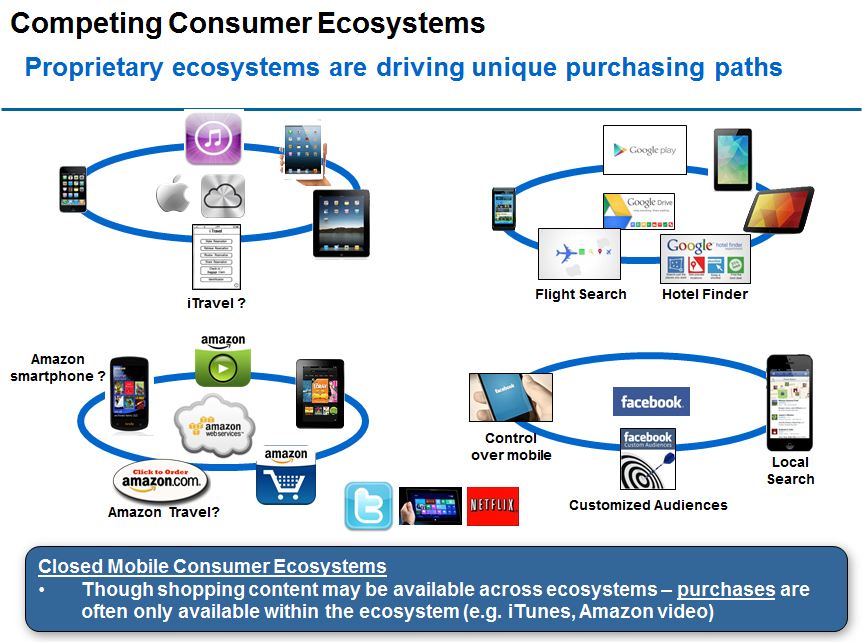
Consumer Ecosystems

I was in Miami last week attending the Farelogix Media Day.  My presentation entitled The Future of Travel Distribution can viewed via SlideShare.   Part of my presentation discussed how competing consumer ecosystems (Apple, Google, Amazon, Facebook) provide unique content and purchasing paths via mobile devices.

Over the next five years mobile devices (including tablets) will become the foundation for most travel e-commerce. As a result airlines can create their own mobile ecosystems around their alliance/joint venture partners

Airline Distribuiton Ecosystem;

Soon airlines will be able to offer specific targeted content to their best customers directly to their mobile device creating a true personalized direct distribution ecosystem.

How Can Regional TMCs Adapt to New Financial Models?

Posted on 30 April 2012 by Norm Rose

The corporate travel market has always been a bit of a paradox. Non-travel industry observers might assume that the big four Travel Management Firms (TMCs) – American Express, Carlson Wagonlit, BCD Travel and HRG – own 80% of the corporate market (the Pareto principle). Though these four TMCs do dominate the Fortune 500, overall they represent less than 50% of the corporate market volume. This is particularly true when you include the full spectrum of companies from unmanaged to lightly managed to heavily managed programs. There are over 100 regional TMCs through the US and 1,000s throughout the world. Despite the Big Recession, many regional TMCs continue to report strong profits and growth, but is this sustainable?

Most regional TMCs are under economic pressure on the fees they charge for their services and the revenues they receive from suppliers and the GDS. A challenging paradox for all TMCs is the issue of online adoption. As TMCs push greater online adoption through corporate booking tools, the service  fees paid by their corporate accounts shrink. For the past decade, the second and third tier TMC market has been complicated by the growth of the Internet-based TMCs, the corporate versions of the OTAs, who have successfully captured major share in the market by promoting low online fees. Competition is still fierce from not only these iTMCs, but the mega-TMCs and the regional TMC’s direct competitors. There is also the continued effort by the suppliers to drive more business direct.

A major source of revenue for TMCs are the backend payments they receive from the GDS and suppliers. The latest airline/GDS battle is driven both by a desire for the airlines to lower their distribution costs and a goal to create a more personalized airline experience by getting closer to the customer and allowing the traveler to bundle ancillary services that meet their needs. On the cost side, the financial assistance which is derived from airline segment fees that are passed through to TMCs is a major target of the airlines’ renegotiation efforts. Airlines are also becoming tougher on the criteria for backend override (commission) payments. Airlines in Europe have begun passing along the cost of credit card fees to the TMC. The major global airline brands are embracing the OpenAxis Group standards with most working with Farelogix on alternative distribution (GDS bypass) strategies. At the end of the day, does this mean the glory days of the regional TMCs are over?

That depends on how these companies adapt to this changing market. Clearly the old ways of doing business will not be sustainable with all these threats to a TMC’s profitability. Here are some suggestions on what regional TMCs can to today:

  • Embrace mobile technology: The business traveler is the early adopter of mobile technology and driving the use of mobile as an essential tool for business travel. Most of the corporate travel industry has been slow to recognize the mobile opportunity. The first step for any TMC is to provide a mobile based itinerary. This can be done by partnering with tools such as TripIt, Tripcase or Worldmate. Integrating these mobile itineraries into the TMC’s overall operation and technology is the key to bring value to these tools. Booking on mobile is still emerging, but a clear trend has already emerged where hotels, cars and ancillary services (restaurants, transfers event tickets, parking) are the first travel items to be sold on mobile. For air tickets, the key is to provide services related to disruption, helping the traveler when something goes wrong (e.g. cancellations, change in trip plans). Partnering with corporate booking tool providers on mobile efforts is a logical path for regional TMCs. The most important opportunity for a TMC’s mobile strategy is the process of continuous engagement. TMCs must execute mobile services that are available throughout the entire trip cycle, providing the right service (personalization) to the right traveler (location) based on the right situation (context).
  • Use BI to offer consulting services : The mega-TMCs have successfully operated consulting practices for over 15 years. Regional TMCs generally offer all services through their account management organizations at no additional fees. By deploying more comprehensive business intelligent platforms (BI) regional TMCs can develop consulting services for a fee. These services include evaluating the impact of negotiated programs and creating and measuring Key Performance Indicators (KPIs) that track traveler compliance and measure travel management effectiveness.

The business world has numerous examples of companies that have not altered their strategy when the market changes, often with dismal results. Regional TMCs throughout the globe cannot not be complacent with current fees and revenue sources and must today embark upon new strategies to sustain profitability over the next decade.

Where in the World is Norm Rose?

Posted on 01 December 2011 by Norm Rose

With all due respect to the classic children’s TV show and game Carmen Sandiego, I have borrowed the show’s tag line having just completed a grueling travel schedule that took me to London, Washington DC, Miami, Rome and Amsterdam all within a five week period. These  trips involved client technology engagements and speeches to various audiences. My Miami stop was to participate as Co-Chair of the PhoCusWright Travel Innovation Summit.  This most recent series of trips augments a busy 2011 travel schedule that included trips to Israel, Orlando, Italy and two trips to Cannes, France.

Travel Tech Consulting provides services that cross all segments of the travel industry (airlines, hotels, OTAs, tour operators, TMCs, government and technology suppliers who support all these segments) with the underlying theme of how emerging technology is changing business practices. A common topic across these speeches and engagements has been the impact of mobile technology and social media on the travel process. Whether addressing audiences in Israel or Amsterdam, I was able to observe first hand the impact mobile technology and social media is having worldwide. Just as much of the traditional travel ecosystem has become accustomed to dealing with online issues, mobile and social are changing the game. As part of various research projects including a comprehensive special report for PhoCusWright entitled “Mobile  Hits the Mainstream”, I have interviewed a wide range of travel and technology companies about the impact of mobile and social media on their strategies. Here are a few observations:

  • In many parts of the world mobile is becoming the primary means to connect to the web.
  • The emergence of tablets is not only un-tethering the travel planning process, but extending the ability to plan and book travel any place at any time. When I returned I was greeted by my new Amazon Kindle Fire, the first under $200 tablet that represents the fusion of the e-reader and media tablet at a lower cost that the market leading iPad (Amazon Kindle Fire is now the #2 tablet worldwide).
  • Audiences and clients all now agree that their customer’s social graph is having a direct influence on travel purchasing and most are struggling to implement an effective social media strategy to target the key influencers while protecting their brand integrity across social media channels.

Now that I am back home in the San Francisco Bay Area and looking out my office window at San Francisco and the Silicon Valley I am amazed how my region which is home to Apple, Google and Facebook is changing the travel industry in every corner of the globe.


Google Flights

Posted on 13 September 2011 by Norm Rose


The much anticipated  integration between ITA Software and Google arrived today with the launch of Google Flight search. The most visible enhancement in this new interface is the instant loading of fares and schedules when you enter the city pairs. The ability to launch flights from the standard Google box which leads you to the flight page ties general search to flight specific schedules and pricing in a way that we have not seen before. Other features such as using a map to locate flights based on a budget from your specific city and the calendar view to look at when cheap flights are available are also delivered instantaneously.

For the industry the biggest news is not the display but the links associated with the booking of these flights. For now the only booking options are the airline sites. TNOOZ quoted Googe’s take on this issue:

Like any other partner, Google needs to honor the airlines’ distribution decisions. It has long been known in the industry that the control of pricing data and distribution of the same by airlines is tightly held. That means that we can only show airlines in the booking links.We will be exploring advertising opportunities within the page to showcase the products and services from other relevant partners, including OTA and metasearch partners. We’d also like to give users and advertisers alike the opportunity to provide feedback so that we could iterate.”

Considering the current tension between the airlines and the GDS/OTAs, this statement by Google is significant. Whether the worst fears of the OTAs and Meta-search companies are being realized (as evidenced by their heavy lobbying effort against the deal) or whether this is a temporary negotiation ploy by Google to obtain greater advertising revenue requiring the OTAs to pay for participation on this screen, is unclear. I suggest you may want to re-read my post on the Google / ITA Acquisition from April to see what else may be in the works from this deal. Certainly key to watch is the impact on mobile flight search!

Airlines and GDS Battle in Court

Posted on 22 April 2011 by Norm Rose

The news this week that USAir has filled a suit against Sabre based on violations of the Sherman Anti-Trust Act comes on the heals of a similar lawsuit filled by AA against Travelport last week. These lawsuits may foretell serious disruption to the traditional travel distribution ecosystem. Most observers would agree that the GDS have been an oligopoly for some time and certainly a monopoly in specific geographic areas. This has been the case since the airlines divested of GDS ownership in the late 1990s and early 2000s. Then why now are USAir and AA suing the GDS over anti-competitive practices?  This is particularly ironic considering that USAir recently renewed their agreement with Sabre. There was clearly some tension in that agreement with an immediate dispute emerging around the nature of the technological innovation associated with the deal.

The issue has always been around costs. The airlines pay the GDS  (on average) close to $3 per segment from US point of sale and sometimes as high as $7 per segment for non-US originating point of sale bookings. With the average record having about 4 segments that adds up to $12- $28 per itinerary. The GDS then use a portion of these funds for financial assistance payments to the travel agency community.  The travel agents generally do not pay the GDS for their technology. These lawsuits are not only bringing to the surface the fact that GDS market power locks travel agents into agreements, it has brought to attention to the general public this revenue stream for travel agents clearly a target of the airlines for many years. A particular focus of the lawsuit is on the corporate travel industry, where TMCs are very GDS-dependent and where the financial assistance helped many TMCs remain profitable despite the economic recession.

I was hopeful we were seeing an era of emerging détente as more airlines signed agreements with the GDS. For some time I believed that the idea of a major airline pulling out of a GDS, or forcing distribution to pay a fee for acess was simply postoring by the airlines during the negotiation process.I now believe this is not just a negotiiation position, but a clear strategy to disrupt the money flow that has existed for years. Farelogix which provides the direct connection standards and platform for alternative distribution is gaining momentum with Delta now joining the other major US carriers with an agreement this week.  Farelogix does not really offer anything the GDS could not from a technological perspective, in other words the GDS are certainly capable of using XML versus EDIFACT for their direct connections to the airlines, it is really is about price and gaining greater control over customer insight and marketing efforts.

Despite all the vocal protests from various industry groups, the DOT has deferred the issue of forcing the airlines to provide the GDS the ancillary services they are offering customers. Some of the airlines are withholding ancillary fees from the GDS as part of their negotiation leverage to force lower distribution costs through the Farelogix platform.  As I mentioned in an earlier blog, a hybrid solution mixing GDS and Open Axis Group (Farelogix) information for ancillary may be one possible future, but given the seriousness of these lawsuits, I believe we will be entering a period beginning this Fall of 2011, where air content will become fragmented particularly causing problems for TMCs who are tied to the GDS as their main platform for distribution. Corporate self booking tool vendors such as Rearden Commerce are hooking into the Farelogix alternative distribution platform, so independent self-booking tools will likely survive this disruption. It is those TMCs that have resisted self-booking and still process the majority of transactions by ph0ne through the traditional GDS that will feel the most pain. This will come in the form of missing content, added fees and loss of financial incentives.

I do not believe the GDS are destined for extinction, but those who are truly abandoning the traditional TPF mainframe environment are better positioned to compete in this new distribution world, to lower their own internal operating costs, provide greater customer targeting and thus may be better positioned to survive this storm in the long term As Google implements ITA and general search becomes meta-search, we may see even greater presure on the traditional system especially if Google were to opt to connect into the Farelogix platform. The increased use of mobile technology as a marketing platform by the airlines will also act as a catalyst for more direct airline/corporate traveler offers. It should be an interesting next 8-12 months.


Orbitz – AA Ruling – Is 2011 the year we will see Permanent Changes in Air Distirbution?

Posted on 22 December 2010 by Norm Rose

News this week that AA successfully defeated the Orbitz  motion for a temporary injunction allowing AA to remove its content from Orbitz has uncovered some interesting news that may foretell major changes in air distribution for 2011 and beyond. As reported in the Beat, sources are indicating that Priceline may be the first of the four major OTAs to contract with AA’s direct connect solution. There is no question that the traditional GDS-based distribution oligopoly is under threat from direct connections. Will these changes ultimately present a different distribution landscape for 2011? I believe these changes represent an evolution not a revolution in distribution, but definitely demonstrate a willingness of the airlines to play hard ball around distribution costs and content.

I believe even the GDS would agree that the day of the  GDS as the sole source of all travel inventory has gradually eroded over time. After all that model preceded the Internet and the resulting changes in distribution allowing airlines, especially Low Cost Carriers (LCCs) the ability to bypass the GDS and sell directly to the consumer. Though many of the GDS have successfully brought some of the LCCs into the fold, the growth and importance of ancillary fee revenue for the traditional carriers and their desire to leverage this content for the latest round of GDS negotiations seems to signal a change in the battlefield away from a pure distribution cost discussion (as was the case in 2005) to an issue around price control and customer value. At its heart, the AA effort is more than simply another attempt at GDS bypass to lower distribution fees, but an attempt by the airline to reshape distribution allowing the airline to control the price and services offered on an individual transaction basis reflecting the true value of the customer.

Given the seriousness of this effort, will 2011 see the breakdown of the traditional GDS model?  Erosion is likely, but a complete shift would require major changes by distributors, the majority of whom oppose the direct connection model. The biggest segment in opposition is the corporate travel market, the most profitable and important segment for the airlines. The corporate buyers represented by NBTA, ACTE and BTC all have voiced opposition to the direct connect effort promoted by AA. The AA challenge is even more acute when you look at the TMC market.  Though dominant, the four largest global TMCs – American Express, CWT, HRG and BCD – do not reflect the classic Pareto principle where they control 80% of the corporate travel market. Among these four large TMCs, no one has publicly endorsed the AA direct connect strategy.  HRG which has built a platform to accept direct content from non GDS sources opposes the new AA strategy. In reality large 2nd tier regional TMCs such as Omega, Travel and Transport, Travelong, and Altour, the online corporate divisions of the OTAs – Egencia, Travelocity Business and Orbitz for Business (which also lost the AA content), and the vast number of 3rd and 4th tier TMCs  all would need to migrate away from their GDS-centric strategy to embrace the AA direct connect model. The leakage in the corporate market  is more likely to come from direct corporate booking tools such as Rearden Commerce that has joined the Open Axis Group or Concur’s Cliqbook which already has direct connects with airlines such as Southwest. Concur has publicly stated that they are awaiting a customer to request a direct connection to AA before introducing the capability to the market. There are obviously economic issues (GDS continue to pay TMCs “financial assistance” based on booking volumes) that inhibit the TMCs from embracing this alternative distribution platform.

If the Beat article is correct and Priceline has agreed to embrace the new AA direct connect strategy, this may influence Expedia to consider it as well. Clearly the fate of Orbitz and Travelocity, being owned by the GDS, is tied up with overall GDS/airline negotiations. The foundation of this dispute is around business practices that are facilitated by new technologies, so ultimately the outcome of this new challenge to traditional GDS centric distribution will ultimately be decided based on business alignment and goals. It is clear though that 2011 will see the first shift of some major revenue to the direct connection channel but ultimately all players within the travel value chain will need to resolve these issues to provide the end customer with the ability to understand and purchase all content from their preferred booking source.

A GDS App Store?

Posted on 07 December 2010 by Norm Rose

There is no question that 3rd party software developers have had a major impact on the technology market. Whether you look at the role of Zynga providing top Facebook apps such as Farmville or the thousands of 3rd party apps in the mobile app stores, no one can deny the impact of third party development on innovation, but what about the travel industry?  What role does 3rd party software developers play in the travel market?  What factors inhibit their contribution to travel innovation?

The GDS have long dominated the technology infrastructure and trends in our industry. With an oligopoly on distribution, the GDS have been able to control 3rd party access to their core systems. Yes all have published APIs based on XML. Yes all have third party developer programs. The difference is in process and control. Even the most restrictive mobile app store, Apple, still has a significantly lower barrier to entry than any of the GDS 3rd party programs. It is certainly understandable that the GDS need to protect their core functionality and opening up their API freely to the market could cause increased traffic without associated revenue and could impact overall performance of the system. The GDS sales teams tasked with signing up 3rd party developers require significant investment ($20K-$40K on average). At the end of the day, the ability for a new third party to innovate using the GDS continues to be constrained by GDS business practices. Each of the GDS have launched new Web based agent desktops. The new Web-based interface has the potential to open up the market for easier access to third party apps, provided the GDS see the light and embrace 3rd party developers in a more open and lower cost way.

Can innovation happen outside the GDS?  Of course, the very existence and influence of ITA software proves that innovation is possible, but even the folks at ITA would admit that dealing with the GDS for their initial launch with Orbitz back in 2000 was a complex and cumbersome process (since then ITA has developed software to project availability without the need to connect to a GDS). Could the pending Google/ITA acquisition change the nature of travel innovation? The pending acquisition presents another potential disruptive platform for 3rd party development particularly if Google/ITA decides to open up their API freely to the 3rd party developer community as they did with Google Maps.

As the co-chair of the PhoCusWright Travel Innovation Summit (TIS), and through my consulting practice , I am on a never ending quest to seek out travel innovation. Often this innovation comes from small companies that build apps to manage travel social media, create mobile travel innovation or deliver new ways to plan travel. Innovation in actual core travel shopping is rare. When it does occur such as the recent launch of Hipmunk, a TIS finalist, access to fares and schedules ultimately needed to come from ITA Software (the deal was announced at the Conference).

Ironically, travel is a common example used by non-travel industry software vendors when developing a proof of concept. It is when these companies try to implement their vision, they find that accessing the core travel data can be an expensive and complicated process.I am hopeful that the Google/ITA acquisition will go through despite some heavy weight opposition and spark a new round of innovation. I am also hopeful that the three major GDS will change their business practices and more actively embrace 3rd party developers, perhaps launching the first GDS app store!

Amadeus One – An IT Company- But it is Up to the TMC to Decide

Posted on 12 October 2010 by Norm Rose

During a briefing today with Amadeus they disclosed the fact that their launch customer for Amadeus One, their new Agent desktop platform is not currently an Amadeus GDS client. The Amadeus One application allows agents to use cryptic formats from any of the major GDS or a graphical user interface to create fare and availability queries. The fare and schedule information is returned in a “sandbox” allowing the agent to manipulate fare quoting in a variety of ways from a variety of sources. For years, Amadeus has been promoting the fact that they are an IT company, not simply a GDS transaction engine. By selling the Amadeus One platform to non Amadeus GDS customers, this does point to truly a change in posture in the market. Now one could speculate that this is simply a competitive necessity to compete with Travelport’s Universal Desktop and Sabre’s Red. The opportunity for the GDS as an IT provider to significantly change the market is more dramatic, but it depends solely on the TMCs willingness to embrace new channels.

An clear battlefield has emerged between the Axis Group of airlines who are promoting the Farelogix XML interface and the traditional distribution players. The corporate travel market represents the true pot of gold for all distributors with the highest yield and frequency of travel and this segment is still controlled by TMCs. Contrary to other industries the big four  TMCs – American Express, Carlson Wagonlit, BCD Travel and HRG do NOT control 80% of the corporate market, with a variety of regional TMCs still thriving despite these difficult times. The real corporate battle lines are with these 2nd and 3rd tier TMCs. When asked whether Amadeus One could connect into the Farelogix XML feed, Amadeus said it was capable of doing this, but it would require the TMC to request this enhancement. The real question is what is going on behind the scenes between the GDS and their TMC customers. In a traditional relationship, the GDS provides financial incentives to the TMC to book segments with that GDS. But in the case where the GDS is providing the front-end technology to a competitor GDS, this incentive does not seem to be a factor. It is then logical to assume that source content should not matter and thus the XML feed from Farelogix should be part of the mix. The value of adopting the Farelogix XML is immediate access to all participating airlines’ ancillary fees. American and recently Delta Airlines have stated that they want to control price and services on a one to one transaction level based on the value of the customer. This would be facilitated through the Farelogix XML. Time will tell whether this represents a change in positioning  for the GDS or a true opening up of distribution sources. TMCs the ball is in your court.

Google / ITA and the GDS

Posted on 27 July 2010 by Norm Rose

Now that the Google acquisition has been announced a great deal speculation has emerged as far as Google’s intentions. Given the fact that regulatory approval is required and that the deal has not been completed, ITA itself has been unable to speculate on Google’s strategy. Google has devoted some energy in stating that it will not become a seller of travel, but hasn’t disclosed specifics on their plans other than stating that it will improve the consumer shopping experience.

This chart which Google introduced regarding the acquisition has some interesting implications. Certainly a main goal of this diagram is to show the world (and the DOJ) that there is competition out there for Analysis/Comparison as part of the ecosystem.  I believe there is more to this diagram than simple positioning.

1) Flights, airfares, availability- Airfare distribution is built on three legs – (1) schedules – published through OAG (2) Fares published through ATPCO and (3) availability housed in the airline passenger reservation systems. Most of the airlines either have their passenger reservation system hosted on a partition of a GDS or use a third party application (which also may be provided by a GDS) to run their reservation process. An area that is being overlooked by much of the press coverage regarding ITA is that fact that they have built a next generation airline passenger reservation system. Pundits are quick to point out that the initial launch customer, Air Canada, postponed the implementation of the new passenger reservation system and point to this fact that the system was a failure. I have no doubt that the system has had problems, but to say it is not functional is too broad of an assumption. Airlines have needed a new passenger reservation platform for decades. The GDS, Navitaire and 3rd party providers such as Radixx all provide platforms. Tech companies such as HP are building a new passenger reservation system for American Airlines. In many cases these systems are actually housed and run by third party companies. The Cloud provides a new spin on passenger reservation systems and Google’s acquisition of ITA may lead to a new player in this sector offering passenger reservations capabilities in the Cloud. This fits well with Google’s Cloud computing emphasis and may signal a significant change in airline distribution.  The current airline/GDS battle is no longer about price as it was back in the last renewal cycle in 2005.  The current controversy is over control over fares, ancillary services and customer ownership. AA is actually stating that they want to deliver every fare and related services on a customer by customer basis through an XML feed deciding on what to charge and what services to include based on customer value.  In Google’s ecosystem chart the airlines are on top and ultimately dictate distribution terms.  A Cloud based passenger reservation system using the ITA software platform could provide more control and flexibility for the airline and actually disrupt the current distribution environment. This means new competition for all vendors in the passenger reservation space and could signal a continued move to more channel based pricing negating the single price published through the single channel model that has been the backbone of the industry for decades.

2) Analysis / Comparison – Back in the early 2000s, ITA  helped accelerate the urgency for the GDS to update their fare quoting software. Whether it was the Worldspan/Expedia Best Fare Search engine or re-written applications from Sabre or Amadeus, ITA forced the GDS to move this function off the mainframe and re-write it so it produced a greater number of choices. The chart shows that the GDS do have an opportunity to replace ITA as the fare quoting engine for airlines or meta-search players, but this is provided that they still have access to total information.  The current push by the Axis group to dictate to that the industry use the Farelogix XML schema has not yet been embraced by the GDS. The GDS are certainly capable of handling XML feeds, but the shifting from a total published environment to one where the airlines passenger reservation system control price and ancillary services could greatly weaken the control the GDS have on distribution. No wonder the audience during our recent PhoCusWright panel discussion wondered why we left the GDS off the list of potential players at risk due to the Google ITA acquisition. This issue may actually play well with the DOJ as the GDS currently have an strong oligopoly on travel distribution and new competition would help improve products for the whole industry.

3) Flight Selection and Sales – The interesting part of this chart is that Google did not list ITA as a direct competitor to the Meta Search players though most of the press and pundits believe this is where they will compete.

One way to look at this chart is that inventory could be delivered through a variety of paths. Airline to 3rd party such as Google/ITA or Vayant and then directly to the airline, for example. With all the current airline/GDS tension, the idea of true GDS bypass may emerge if the acquisition is approved. Don’t get me wrong,  I often believe the industry’s rhetoric that the GDS are dinosaurs and will fade into history, is similar to the famous Mark Twain quote” “The reports of my death have been greatly exaggerated.”.  I believe the GDS are strong players within the travel distribution landscape and will remain so for many years to come.  A Google ITA Cloud alternative combined with the airlines push for more control may mean that new competition is on the horizon for the GDS.

GUI Finally Comes to the Agent POS

Posted on 09 July 2010 by Norm Rose

Graphical User Interfaces (GUIs) were first introduced to the public with the original Apple MAC  in 1984. The MAC as well as the first version of Microsoft Windows were actually based on technology developed by Xerox PARC back n the early 1980s. The GUI became mainstream with the introduction of Microsoft Windows and by the early 1990s most consumers were accustomed to using a mouse to navigate icons on the desktop. Given this historical perspective it may seem odd that the majority travel agents still work on native GDS cryptic formats. 2010 has seen the introduction of new Web based POS platforms from the three major GDS, Amadeus, Travelport (not yet released) and Sabre.

Could 2010-2011 be the years that travel agents finally move to a more modern desktop? It is important to note that these platforms also allow the agent to use the standard cryptic formats and most have been created to incorporate existing scripts, so it may not be a complete transition to a GUI for some agents. Planet Sabre, the industry’s first Internet-enabled application for travel agencies, was introduced in early February 1997, but was never widely adopted. GUI interfaces from 3rd parties such as TRX, Pass Consulting and others also failed to gain broad market acceptance. So what’s changed?  I believe there are three  primary drivers that will make the new Web-based agent POS gain market acceptance over the next few years:

Amadeus Selling Platform

1) The Fragmentation of Content-  According to an ASTA survey nearly 81% of the agents said they have booked directly on a supplier’s Web site without using a GDS or calling the supplier. Air and hotel are the components most likely to be booked online.In Europe with the majority of hotels independent, the addition of rail as an option and the growth of LCC in all markets, fragmentation of inventory is a reality. A Webtop interface will allow the integration of disparate inventory pieces in a more productive manor.

  • Sabre Red Workspace
  • 2) Staffing Challenges – Contrary to common wisdom, travel agents have not been put out of business by the Internet. But this perception has narrowed the employment pool for new agents. GUI interfaces allow travel agencies to hire new agents who no longer need to know complex GDS formats, but who possess superior customer service skills.

    Travelport Universal Desktop

    3) Airline ancillary fees- The extra charges for baggage, meals, pillows and preferred seats has complicated the travel selling process. Though GDSs such as Sabre have introduced cryptic format solutions for the ancillary fees, they and the other GDS agree that the level of complexity created by airline ancillary fees is better suited for a GUI interface.  The amount of complexity will likely to increase as airlines expand their merchandising efforts.

    Though these are the main benefits of the new platforms, other benefits such as the ability to provide more personalized service through the integration of CRM data, the ability to compare prices from multiple sources and better integration of email and social networking into the agent desktop are few of the additional benefits on these new platforms.

    The GDS are not the only providers of Web-based multi–source agent desktops. My colleague at PhoCusWright, Bob Offutt is publishing a piece next month for the Innovation Edition comparing various third party multi-source POS systems.